ReddRadar

What is GreptimeDB?
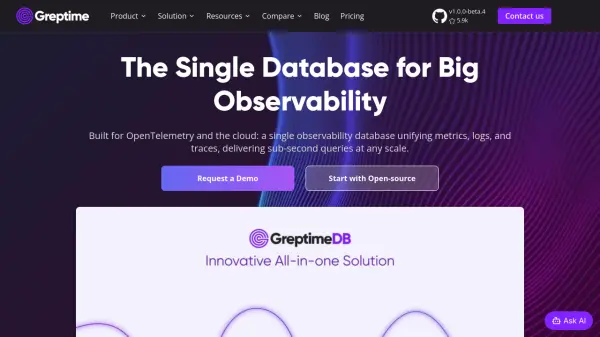
GreptimeDB functions as a comprehensive observability database engineered to unify metrics, logs, and traces through a single platform. It supports real-time data processing with high-performance ingestion and querying capabilities, delivering sub-second responses even on petabyte-scale datasets. Built with Rust for reliability, it features rich indexing options and handles hundreds of thousands of concurrent requests efficiently.
The database employs a compute-storage separation architecture to achieve up to 50x lower operational and storage costs, scaling flexibly across cloud storage systems like S3 and Azure Blob Storage. It offers seamless integration with existing monitoring ecosystems through multi-protocol support for OpenTelemetry, Prometheus, and InfluxDB, alongside SQL and PromQL interfaces. Deployment options range from ARM-based edge devices to cloud environments, providing unified APIs and bandwidth-efficient data synchronization.
Features
- High-Performance Engine: Built with Rust for reliability, featuring rich indexing options like inverted, fulltext, skipping, and vector indexes to accelerate queries and enable sub-second responses on petabyte-scale datasets.
- Significant Cost Reduction: Achieves up to 50x lower operational and storage costs through a compute-storage separation architecture, scaling flexibly across cloud storage systems like S3 and Azure Blob Storage.
- All-in-One Observability Database: Unifies metrics, logs, and traces in real-time with full SQL, PromQL, and streaming processing support, replacing complex legacy data stacks with a single solution.
- Infinity Scalability: Purpose-built for Kubernetes and cloud environments with industry-leading compute-storage separation, enabling unlimited cross-cloud scaling and efficient management of cardinality explosion.
- Developer-Friendly: Provides standardized SQL/PromQL interfaces through built-in web dashboard, REST API, and MySQL/PostgreSQL protocols, with native support for OpenTelemetry and other data ingestion protocols.
- Flexible Deployment Options: Deployable anywhere from ARM-based edge devices to cloud environments with unified APIs and bandwidth-efficient data synchronization, allowing seamless querying of edge and cloud data.
Use Cases
- Mission-critical systems monitoring and analytics in large-scale distributed environments
- Real-time observability data collection for IoT and automotive applications
- Unified metrics and logs management for cloud-native applications
- High-performance querying of massive log data at scale with multi-cloud deployment flexibility
- Replacement for complex legacy data stacks like Prometheus, InfluxDB, and Loki in observability pipelines
- Edge-cloud integrated solutions for automotive and industrial IoT scenarios