ReddRadar

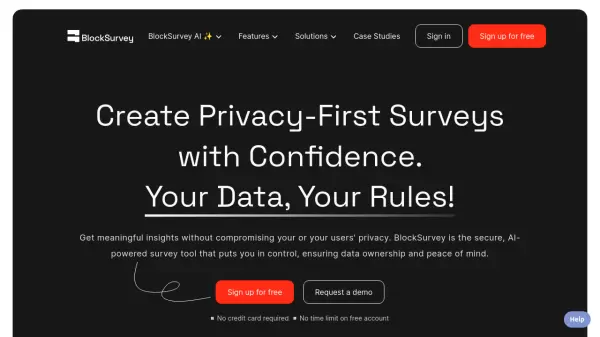
What is BlockSurvey?
BlockSurvey is an innovative survey platform that combines advanced AI capabilities with robust privacy features. The platform employs end-to-end encryption and blockchain technology to ensure complete data security and ownership, making it ideal for organizations handling sensitive information.
The platform offers comprehensive survey creation tools, including AI-powered question generation, multilingual support for over 100 languages, and advanced features like conjoint analysis and token-gated access. With its focus on user privacy and data protection, BlockSurvey helps organizations maintain compliance with major security standards including ISO 27001, SOC2, HIPAA, and GDPR.
Features
- End-to-End Encryption: Secure data collection with blockchain technology
- AI Survey Creation: Generate high-quality questions quickly using AI
- Complete Anonymity: Create fully anonymous surveys with no tracking
- Multilingual Support: Create surveys in 100+ languages
- Token-Gated Access: Control access across 10+ blockchain networks
- White Label Customization: Brand surveys with custom domains and logos
- Advanced Analytics: AI-powered data analysis and insights
- Compliance Standards: ISO 27001, SOC2, HIPAA, and GDPR certified
Use Cases
- Market Research
- Employee Surveys
- Customer Feedback
- Mental Health Assessments
- Community Engagement
- Product Testing
- Academic Research
- Web3 Community Surveys
FAQs
-
How is BlockSurvey different from traditional survey platforms?
BlockSurvey differentiates itself through end-to-end encryption, complete data ownership, privacy-first design, AI-driven efficiency, and Web3 capabilities like token-gating. -
How does BlockSurvey ensure respondent privacy?
BlockSurvey ensures privacy by not running ads, trackers, or browser fingerprinting, and implementing end-to-end encryption where only the survey data collector can access the information. -
What compliance certifications does BlockSurvey hold?
BlockSurvey holds SOC2 and ISO 27001 certifications, and complies with HIPAA and GDPR regulations.