ReddRadar

What is Symbiont?
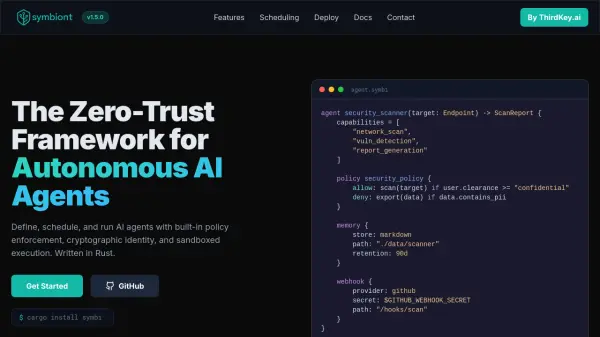
Symbiont provides a comprehensive framework for deploying secure autonomous AI agents with enterprise-grade security features. Built in Rust for memory safety, it offers a declarative DSL (Domain-Specific Language) that allows developers to define agents with inline policy enforcement, capabilities, permissions, and security constraints in a single file. The framework includes cryptographic identity verification through AgentPin ES256 credentials, ensuring every agent's origin can be verified before execution.
The platform features a built-in cron scheduling engine with dead-letter queues, heartbeat monitoring, and ephemeral sessions for reliable agent execution. It provides sandboxed execution environments with Docker and gVisor isolation tiers, configurable resource limits, and network policies. Symbiont includes embedded vector search via LanceDB for persistent agent knowledge, RAG (Retrieval-Augmented Generation) capabilities, and optional Qdrant support. The framework supports multiple SDKs including JavaScript and Python, with comprehensive observability through Prometheus-compatible metrics and structured output delivery to various endpoints.
Features
- DSL & Policy Engine: Declarative agent definition with inline policy enforcement for capabilities, permissions, and security constraints
- Cryptographic Identity: AgentPin ES256 credentials anchored to domains via .well-known for origin verification
- Sandboxed Execution: Docker and gVisor isolation tiers with configurable resource limits and network policies
- Built-in Scheduling: Cron engine with dead-letter queues, heartbeat monitoring, and ephemeral sessions
- Embedded Vector Search: LanceDB integration for semantic retrieval and persistent agent knowledge with optional Qdrant support
- Observability: Prometheus-compatible metrics for tracking run counts, durations, failures, and in-flight jobs
- Memory Management: Markdown-backed agent memory with retention-based compaction and automatic context management
- Security Hardening: API key authentication with Argon2 hashing, rate limiting, and sensitive parameter redaction
Use Cases
- Security scanning and vulnerability detection for network endpoints
- Automated compliance reporting for regulated industries (HIPAA, SOX, PCI-DSS)
- Scheduled monitoring and metrics collection for DevOps automation
- Multi-agent platforms with verified identities and centralized observability
- Incident response automation with policy-enforced agent execution
- Data backup and maintenance tasks through scheduled agent workflows
- Real-time communication integration with Slack, Microsoft Teams, and Mattermost
- Webhook processing with HMAC-SHA256 and JWT signature verification
FAQs
-
What programming languages does Symbiont support for agent development?
Symbiont supports multiple languages through SDKs including JavaScript and Python, with the core framework written in Rust. -
How does Symbiont handle agent identity verification?
Symbiont uses AgentPin ES256 cryptographic identity anchored to domains via .well-known discovery, allowing verification of agent origins before execution. -
What isolation options are available for agent execution?
Symbiont provides Docker and gVisor isolation tiers with configurable resource limits and network policies for sandboxed execution. -
Can Symbiont integrate with external services and tools?
Yes, Symbiont offers optional MCP tool integration via Composio to connect agents to 250+ external services with a single API key. -
What metrics and observability features does Symbiont provide?
Symbiont offers Prometheus-compatible metrics for tracking run counts, durations, failures, in-flight jobs, and supports export to files or OTLP endpoints.
Related Queries
Helpful for people in the following professions
Symbiont Uptime Monitor
Average Uptime
0%
Average Response Time
0 ms