ReddRadar

What is ReductStore?
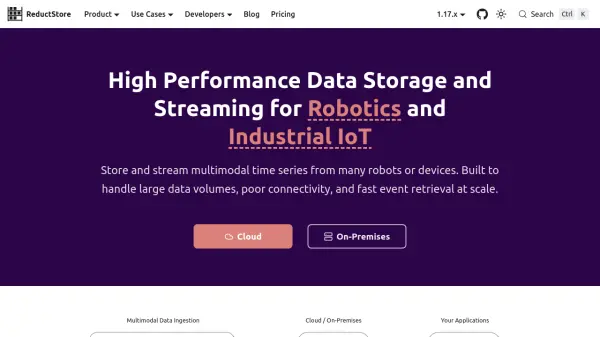
ReductStore is a specialized time-series database engineered for robotics and industrial IoT applications. It stores multimodal time series data of any size and format, including images, video, LiDAR, IMU, logs, files, and ROS bags. The system is built to handle large data volumes, poor connectivity, and fast event retrieval at scale, making it ideal for fleet-scale collection from many robots or devices.
The platform supports selective edge-to-cloud replication with rules based on labels or events, even with limited bandwidth. It reduces cloud costs by batching records into fewer objects for S3-compatible storage and maintains performance with high throughput ingestion. ReductStore includes features like retention quotas, fast event retrieval, extensible query engines, and token authorization, supported by SDKs in Python, JavaScript, Go, C++, and Rust.
Features
- Multimodal Data Storage: Store time-ordered records of any type and size, including images, video, LiDAR, and ROS bags
- Selective Replication: Replicate data from edge to cloud using rules based on labels or events, even with poor connectivity
- Cost Optimization: Batch records into fewer objects for S3-compatible storage to reduce API overhead and cloud costs
- High Performance: Optimized for fast writes and reads, with benchmarks showing significant speed advantages over alternatives
- Extensible Query Engine: Use extensions to transform data during queries, such as resizing images or filtering CSV
Use Cases
- Robotics data pipelines for AMRs, drones, and ROS systems
- Data acquisition for manufacturing edge computing and AI applications
- Computer vision implementations in industrial settings
- Vibration sensor data storage and management
- MQTT data storage for IIoT applications
FAQs
-
What deployment options are available for ReductStore?
ReductStore offers fully on-premises, cloud on your infrastructure, or managed cloud deployments, all with the same features. -
How does disk usage licensing work?
You receive a license key specifying allowed disk usage; if exceeded, the database continues working with warnings in CLI, WebConsole, and SDKs. -
What happens when the license expires?
The database keeps running, but CLI, WebConsole, and SDKs will show license warnings.