
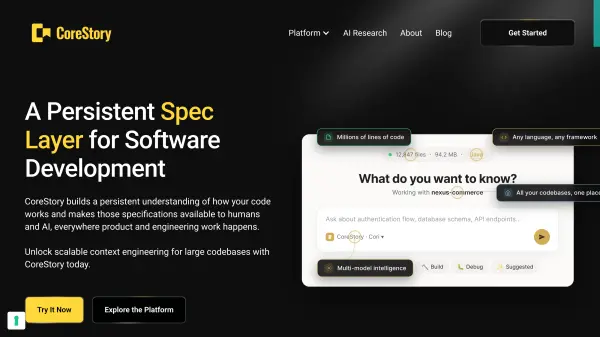
What is CoreStory?
Features
- Persistent Intelligence Model: Continuously ingests code and documentation to build a durable, unified model of system architecture, behavior, and intent.
- Multi-Model Intelligence: Supports any language, any framework, and multiple codebases in one place.
- AI Agent Integration: Connects with AI coding agents like Claude Code, GitHub Copilot, Cursor Composer, Devin, and Codex via MCP and API.
- Ready-To-Use Playbooks: Pre-built playbooks that plug directly into coding agents for up to 44% improved results.
- AI-Assisted Spec Generation: Accelerates product and engineering workflows with guided specification creation.
- Role-Based System Understanding: Tailored insights for architects, engineers, planners, and new hires from a single shared intelligence model.
- Legacy Codebase Support: Deep code analysis to support modernization, migration, and maintenance of legacy systems.
- Automatic Code Documentation: Turns AI-generated black-box code into fully documented, understandable specifications.
Use Cases
- Modernizing and migrating legacy applications with full system comprehension
- Maintaining and extending existing software systems with deep architectural insights
- Documenting and managing technical debt from AI-generated code
- Accelerating developer onboarding to complex and unfamiliar codebases
- Providing AI coding agents with durable, queryable system context for safer and more accurate code generation
- Supporting architects and staff engineers with system-level design and incident analysis
- Enabling product managers and business analysts to define realistic requirements and roadmaps
- Reducing regressions during refactoring by grounding changes in accurate system understanding
How It Works
Ingest Your Codebase
CoreStory continuously ingests your source code, static documentation, and custom inputs from your software systems regardless of language or framework.
Build a Persistent Intelligence Model
The platform constructs a unified intelligence model that captures your system's architecture, workflows, business rules, and developer intent — grounded directly in your code.
Access System Understanding Across Roles
Architects, engineers, planners, new hires, and AI agents can query the shared intelligence model to get accurate, role-relevant insights on demand.
Integrate with AI Agents and Developer Tools
Connect CoreStory to AI coding agents like GitHub Copilot, Claude Code, or Cursor Composer via MCP/API integrations or use ready-to-use Playbooks for immediate productivity gains.
Generate Specs and Improve Delivery
Use AI-assisted spec generation to accelerate product and engineering workflows, reduce regressions, and ensure more predictable software delivery.
FAQs
-
What types of codebases does CoreStory support?
CoreStory supports any language and any framework, making it suitable for diverse and multi-codebase environments, including large enterprise legacy systems. -
Which AI coding agents can integrate with CoreStory?
CoreStory integrates with AI coding agents such as Claude Code, OpenAI Codex, Devin, Droid, GitHub Copilot, and Cursor Composer via MCP and API integrations. -
How does CoreStory differ from traditional context engineering solutions?
Unlike traditional solutions that rebuild context per session or tool, CoreStory maintains a persistent intelligence model that compounds over time, survives team turnover, and is accessible across all tools and roles. -
What are CoreStory Playbooks?
Playbooks are ready-to-use configurations that plug CoreStory's intelligence directly into coding agents of your choice, and have demonstrated up to 44% better results from those agents. -
How can I get started with CoreStory?
You can sign up for the waitlist, try it now through the platform, or book a demo with the CoreStory team to see the platform in action.