ReddRadar

What is Boxbot?
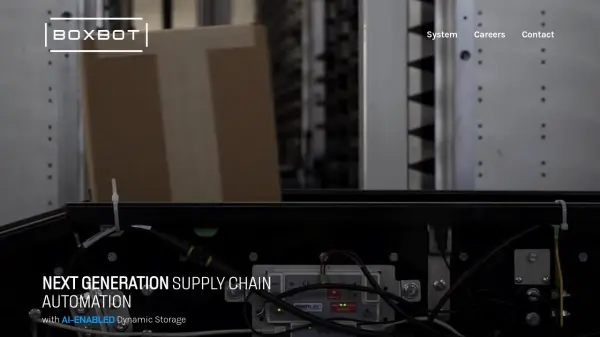
Boxbot introduces automated, high-density storage solutions that enhance logistics operations through AI-driven capabilities. The system utilizes proprietary storage trays linked to standard conveyors, enabling hands-free load and unload processes without the need for pick or load stations. It supports variable item sizes and weights through multiple storage tray dimensions and variable height storage based on item size.
The platform is designed with a modular gantry-based architecture for maximum reliability in industrial settings, featuring ease of accessibility, low maintenance, and no single point of failure. It offers flexible applications such as last-mile delivery stations, air cargo or bonded storage, cross-dock buffering, and automated counter retrieval. The Boxbot Operating System (BOS) uses AI to optimize performance, adapt to environments, and provide full-stack sensor fusion for robust monitoring and fault avoidance.
Features
- Dynamic Storage: Real-time space allocation enables dense storage of variable-sized items, minimizing wasted volume.
- Hands-Free Load/Unload: Automatically stores and removes items from proprietary storage trays linked to standard conveyors without pick or load stations.
- Variable Item Sizes & Weights: Supports multiple storage tray dimensions and variable height storage based on item size and weight.
- Robust & Fault-Tolerant Design: Modular gantry-based architecture with no single point of failure, designed for reliability in industrial settings.
- Flexible Applications: Suitable for last-mile delivery stations, air cargo storage, cross-dock buffering, and automated counter retrieval.
- Scalable Platform: Modular and customizable system using standard components, configurable for greenfield or brownfield deployments.
- Boxbot Operating System (BOS): AI-powered system that optimizes performance, adapts to environments, and provides sensor fusion for monitoring.
- Network Optimization: Enhances supply chain resilience through load balancing, merge-in-transit capabilities, and last-mile delivery optimization.
Use Cases
- Streamlining vehicle loading, order management, and wave dispatch in last-mile delivery stations.
- Automating customs storage and inspections in air cargo or bonded storage facilities.
- Grouping, sequencing, and sorting items in cross docks for optimal pallet building and dispatch.
- On-demand single item retrieval in industrial or public-facing areas using automated counters.
- Managing volume smoothing to handle labor needs and throughput challenges in logistics facilities.
- Enabling wave- or shift-based workflow management for improved operational efficiency.
- Load balancing to mitigate volume shocks and enhance supply chain flexibility.
- Merge-in-transit of split shipments with full digital control for network optimization.
FAQs
-
What items can be stored in a Boxbot System?
Cartons, cases, totes, and other items can be stored on standard Boxbot trays. Small polybags, letters, cylinders, bags, and irregular objects can be handled once placed in totes. The smallest accepted item is 6”x6”x1” and 1 lb, while the largest is 35”x24”x24” and 75 lbs. -
How tall can the systems be built?
Modules can be built up to 25 feet in height. -
What throughput rates are achievable?
System throughput ranges from 250 pieces per hour (PPH) to over 4,000 PPH, depending on the number and size of modules added. -
Who should use Boxbot?
Any application handling sub-unit load items for buffering or storage, especially with size or weight variations. It excels in parcel delivery, 3PL, airport, industrial, and retail sectors for individually handling cases or post-pack eaches.