ReddRadar

What is Bazel?
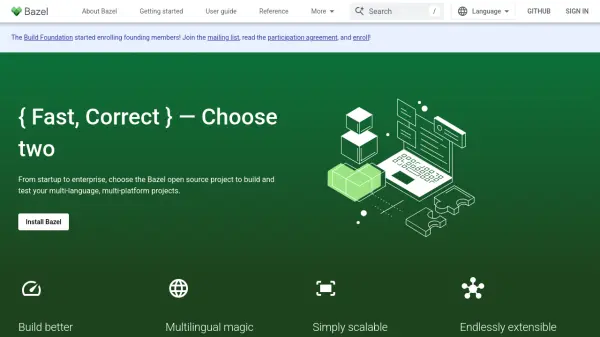
Bazel is an open-source build and test tool designed for projects of any size, from startup to enterprise. It provides fast, incremental builds by rebuilding only what is necessary, leveraging advanced local and distributed caching, optimized dependency analysis, and parallel execution.
Supports building and testing with multiple languages including Java, C++, Go, Android, and iOS across Windows, macOS, and Linux platforms. Bazel scales seamlessly from small codebases to massive monorepos, making it ideal for organizations with complex build requirements.
Supports building and testing with multiple languages including Java, C++, Go, Android, and iOS across Windows, macOS, and Linux platforms. Bazel scales seamlessly from small codebases to massive monorepos, making it ideal for organizations with complex build requirements.
Features
- Incremental Builds: Rebuild only what is necessary using advanced caching and dependency analysis.
- Multilingual Support: Build and test projects using Java, C++, Go, Android, iOS, and more.
- Cross-Platform: Runs on Windows, macOS, and Linux.
- Scalability: Handles codebases of any size, including huge monorepos.
- Extensibility: Add support for new languages and platforms with Bazel's extension language.
- Parallel Execution: Optimizes build times with parallel task execution.
Use Cases
- Building and testing large-scale software projects.
- Continuous Integration and Continuous Delivery (CI/CD) pipelines.
- Managing monorepos with multiple languages and platforms.
- Developing cross-platform applications.
- Accelerating developer workflows with fast incremental builds.
FAQs
-
What is Bazel?
Bazel is an open-source build and test tool developed by Google that supports fast, incremental builds for multi-language, multi-platform projects. -
What languages does Bazel support?
Bazel supports Java, C++, Go, Android, iOS, and many other languages and platforms. -
Is Bazel free to use?
Yes, Bazel is a free and open-source project. -
Who uses Bazel?
Industry leaders like Google, Stripe, and Dropbox rely on Bazel to build mission-critical software. -
Does Bazel work on Windows?
Yes, Bazel runs on Windows, macOS, and Linux.