ReddRadar

What is Amverum?
Amverum provides a cloud platform designed to streamline the deployment and management of IT applications, including bots, websites, and microservices. It leverages Git-based workflows, allowing users to deploy and update projects via simple pushes to a Git repository or through a graphical user interface (GUI). The platform supports various programming environments such as Python, Java, Node.JS, Golang, C#, Ruby, PHP, and Docker, with automated configuration and scaling capabilities.
The service includes managed database clusters (e.g., PostgreSQL, Redis, MongoDB, MySQL) and features like horizontal and vertical scaling, auto-recovery, and full data backups. It aims to reduce infrastructure administration overhead by handling server configurations, orchestration, and updates, enabling developers to focus on their projects. Amverum uses container technology and Kubernetes for efficient resource management and high availability.
Features
- Git-Based Deployment: Deploy and update projects via simple pushes to a Git repository or through a GUI
- Multi-Language Support: Built-in support for Python, Java, Node.JS, Golang, C#, Ruby, PHP, and Docker environments
- Managed DBMS: Deploy managed PostgreSQL, Redis, MongoDB, and MySQL clusters starting from $3 per month
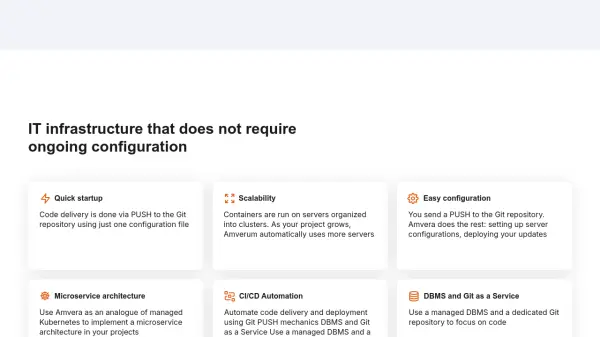
- Scalability: Horizontal and vertical scaling with automatic server allocation as projects grow
- Auto-Recovery: Automatic restart of projects within 10-15 minutes in case of failures
- Data Backup: User data and repositories stored in triplicate with daily backups in independent data centers
- Microservice Architecture: Use as an alternative to Kubernetes for deploying systems with multiple microservices
- CI/CD Automation: Automate code delivery and deployment using Git PUSH mechanics
Use Cases
- Deploying and updating bots, websites, and IT applications
- Implementing microservice architectures without complex network configuration
- Developing and deploying custom machine learning solutions
- Creating and managing Telegram bots for voice message recognition
- Hosting commercial services with moderate to high load requirements
- Testing and running applications with minimal infrastructure setup
- Migrating projects from platforms like Heroku to a simplified cloud environment
FAQs
-
What is a container in Amverum?
A container is an isolated environment for an application with all necessary program files, designed to run a single service or function, making it lighter and faster than virtual machines. -
Who configures containers in Amverum?
Amverum uses Kubernetes technologies to orchestrate containers, handling administration, server connections, and configuration automatically, so users only need to send pushes to the Git repository. -
How does Amverum ensure data safety?
Amverum stores user data and repositories in triplicate on different servers and performs daily backups in an independent data center to guarantee high availability and integrity. -
What programming languages does Amverum support?
Amverum supports Python, Java, Node.JS, Golang, C#, Ruby, PHP, and Docker environments, with built-in configuration options in the UI. -
How can I migrate from Heroku to Amverum?
Instructions are provided on the website for migrating services from Heroku to Amverum, detailing steps to transition projects to the platform.